Just named executor?
Nobody trained you for this. Here’s the entire job, mapped.
A plain-English guide and toolkit that turns the whole executor job into simple next steps — from the first phone call to the final signature. Read it tonight. Feel the weight lift.
Instant access · 30-day money-back guarantee · $99





 Trusted by 4,700+ executors
★★★★★ customer-reviewed · Reviewed and approved by a practicing estate attorney
Trusted by 4,700+ executors
★★★★★ customer-reviewed · Reviewed and approved by a practicing estate attorney
Someone you love died, then you inherited a tough job.
Nobody trained you for it. There was no orientation, no manual in the drawer, no manager to ask.
You’re suddenly responsible for bank accounts, a house, bills addressed to a person who is gone, and relatives asking questions you can’t answer yet. If you’ve sorted condolence cards and utility bills in the same pile, you’re not doing it wrong. That’s simply what this job is.
Here’s what nobody tells you at the start: the job has a shape. It’s the same twelve tasks for almost every estate, in almost the same order — and most of them are smaller than they look from the outside. What makes the role feel impossible isn’t the work. It’s not knowing what comes next, whether you’re behind, or which of the twenty urgent-sounding things actually matters.
The shape can be learned in an evening. That’s what this page is about.
The part nobody warns you about
Why good people get hurt doing this job
Most executor problems aren’t what you’d guess. Court clerks answer “which form” questions all day. Probate is paperwork with a referee, not a trial.
The real trap is quieter — and it has your name on it:
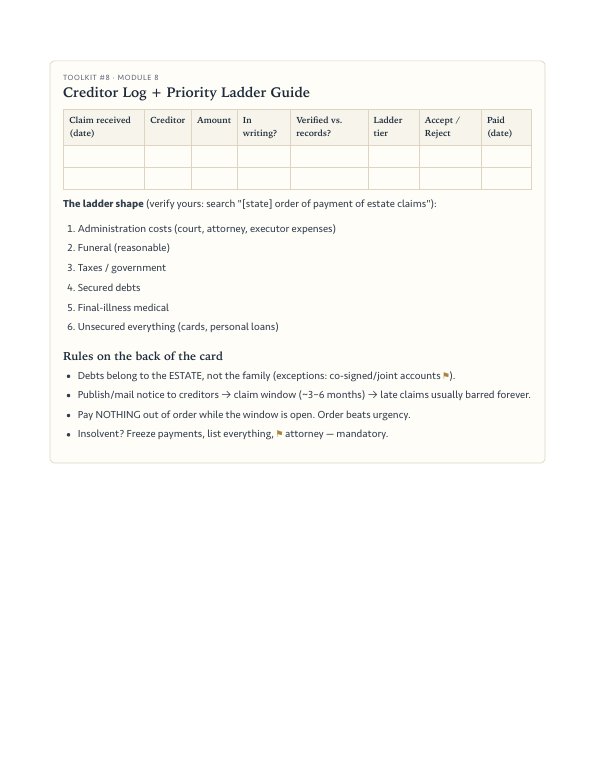
Estate debts follow a legal payment order, written into state law. Taxes and administration costs rank near the top. Credit cards rank at the bottom. And if you pay in the wrong order and the estate runs short, the shortfall can be looked for in your own pocket. Not the estate’s. Yours.
It happens quietly, to responsible people. The credit card company calls weekly, sounding urgent. The IRS never calls at all. So the overwhelmed executor pays the loud bill in month two — and learns in month six that the estate can’t cover the tax bill that legally ranked above it.
And the payment ladder is only the sharpest example of a pattern that runs through the whole role. Mixing estate money with your own “just for now” is the fastest way an honest executor ends up looking like a dishonest one. Handing out belongings before probate creates legal exposure and a year of family grievance accounting. None of these are intelligence failures. They’re sequence failures.
The standard isn’t perfection. It’s explainability — and explainability is a system, not a talent. One account the money flows through. One log every dollar lands in. One order the bills get paid in. The right things, in the right order, with the paper to prove it.
That danger you didn’t know had a name? The System was built around defusing it.
The entire job, on one map
Twelve short modules. Three phases. One clear order.
Each module ends with a template from the Toolkit and a single action step. Do the step, move on. That’s the whole method — one step, in the right order, with the paper to prove it.
- Breathe First. The first 48 hours: the three things that matter — and official permission to ignore everything else.
- The Three Keys. Death certificates, the will, the paper trail. Get these three, and every locked door ahead of you opens.
- Your Badge: Probate Without Fear. Whether you even need probate — and the one court-stamped page that makes every bank open.
- The Paper Fortress. One spreadsheet, four tabs. Executors get accused; records get exonerated.
- Money Rules. The estate becomes its own entity, with its own tax ID and account. One river, one clean record.
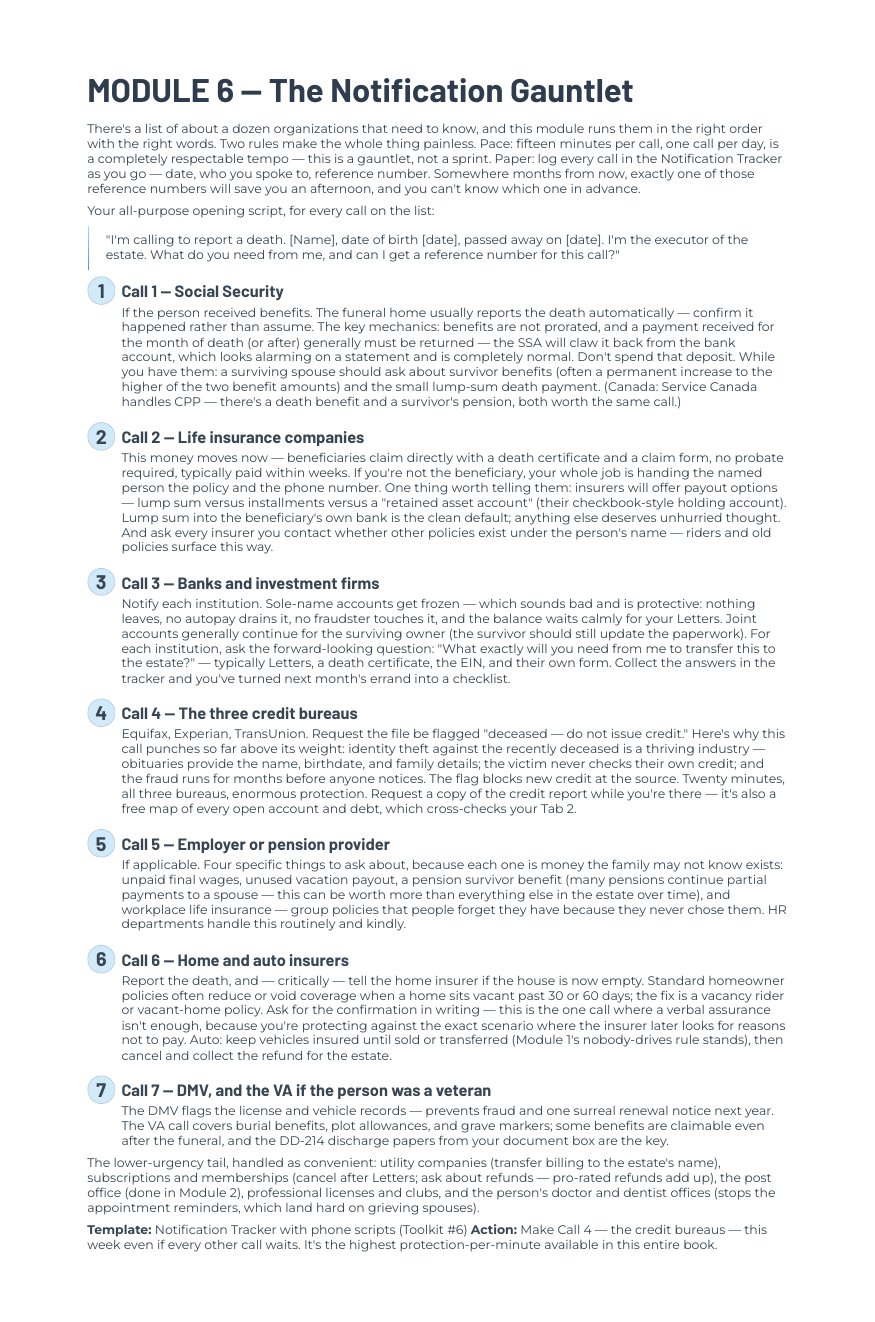
- The Notification Gauntlet. About a dozen organizations, in the right order, with the exact words to say.
- Scam Armor. The three attacks that follow every obituary — and the one house rule that defeats them all.
- Debts in the Right Order. The priority ladder and the claim window. The module that keeps a shortfall out of your pocket.
- Taxes Without Terror. The three possible returns, and the step-up rule that saves ordinary families five-figure sums.
- The House (and Everything In It). Appraise before anyone “helps you” price it. Then sell, transfer, or rent — decided in the right order.
- Family Diplomacy. The monthly two-line email that works like litigation insurance, plus scripts for the five hardest conversations.
- Distribution Day & Closing the Book. The pre-distribution gate, the one-page release, and how to close so it stays closed.
Every ⚑ flag in the guide marks a “hire the attorney” moment — the exact situations where doing it yourself ends (two wills, an insolvent estate, a beneficiary who lawyers up), why, and how the estate — not you — pays for the help.
Instant access · 30-day money-back guarantee · $99
Built for real life
How you’ll actually use it
Tonight: read Module 1 — or press play on the audiobook. It covers the only three things that matter in the first 48 hours and gives you official permission to ignore everything else. The banks, the will, the bills — all of it can wait two weeks, and the guide explains why that’s not just safe but correct.
This week: print the Phase I checklist and start the document box. The templates do the organizing; you just fill them in as things surface.
For the life of the estate: it works as a reference, not a reading assignment. Something happens — a creditor letter, a sibling question, a form you’ve never seen — and you find the module, do the step, and log it. It was built to be used at 11pm, mid-panic, with one hand.
Look inside
Real pages from the actual guide
Everything you get
Everything you need. Nothing you don’t.
- The 26-page step-by-step guide — the complete job, first phone call to final signature, in plain language.
- The 68-minute audiobook — the whole System, narrated, for when reading is the last thing you want to do.
- All 12 fill-in templates — the estate inventory, the money log, the notification tracker with phone scripts, the creditor log with the priority-ladder guide, and more. You never start from a blank page.
- 3 printable phase checklists — the whole job on three pages. Tape them up. Crossing off is the therapy.
- Word-for-word scripts — for banks, creditors, scammers, and the five hardest family conversations.
- Lifetime access and updates — the System improves; your copy improves with it.
Here’s the math worth knowing before anything else. If you hand the whole job to an attorney — gathering the assets, contacting the banks, paying the debts, advertising for creditors, distributing the funds — that’s called full estate administration, and it’s billed hourly or as a percentage of the estate’s value. For a novice executor, it can easily total $4,000 to $10,000 or more, depending on complexity. Even a single consult hour runs $250–$500 — and much of that hour goes to questions this guide answers.
Getting organized and prepared with the System can literally save you thousands — because the estates that stay cheap are run by executors who show up with the inventory done, the log kept, and the right questions ready. And when a situation genuinely needs a lawyer, the ⚑ flags say so plainly: skipping the attorney when two wills surface would cost far more than any fee. The System makes you the organized client whose bill stays small.
Instant access · 30-day money-back guarantee · $99
Customer reviews
A clearer path through a difficult job.
“When I was named executor for my mother’s estate, I had no idea where to begin. Every search gave me another list of things to worry about. This system put everything into a clear order and helped me focus on what actually needed to happen next. For the first time since she passed, I felt capable instead of completely overwhelmed.”
“I’m organized in my professional life, but dealing with my father’s estate was different. There was grief, paperwork and pressure from every direction. The Executor Success System gave me a path through the fog. I could see what was urgent, what could wait and what records I needed to keep.”
“The templates were worth the price on their own. I wasn’t staring at a blank page wondering what to write or whether I had forgotten something important. I could adapt what was provided, communicate more clearly with everyone involved and keep moving forward.”
“The hardest part wasn’t only the paperwork—it was keeping my siblings informed without creating more confusion. The system helped me document decisions and communicate more consistently. That structure made difficult family conversations much calmer.”
“I expected something filled with legal language that would make me feel even more intimidated. Instead, everything was explained in a clear and respectful way. I could work through it in manageable sections without feeling like I had to become an estate expert overnight.”

“Before buying this, I was constantly wondering whether I was doing things in the right order. The checklists gave me a way to confirm what I had completed and what was still outstanding. I stopped second-guessing every step and became much more confident in the role.”

“At the beginning, the estate felt like one enormous problem with no obvious starting point. This system broke it into manageable steps I could complete one at a time. That sounds simple, but when you’re grieving and exhausted, it makes an enormous difference.”

“I spent weeks collecting advice from different websites and trying to build my own process. Once I found the Executor Success System, everything became much clearer. I wish I’d had it from day one—it would have saved me a lot of unnecessary stress and duplicated work.”

“I wanted to honour my aunt by handling her affairs carefully, but I was terrified of overlooking something. Having the process mapped out gave me a sense of control and reassurance. More importantly, it helped me feel that I was carrying out her wishes with the care they deserved.”

“There are so many expenses involved in settling an estate, but this was one purchase that immediately made the process easier. It gave me structure, practical documents and a clear picture of the job ahead. Honestly, it may have been the best $97 I spent during the entire process.”
Swipe to read more →
The guarantee, plainly
Use it for 30 days. If it isn’t what you needed, reply to your receipt and you get every dollar back, no questions asked — and you keep the templates. That’s the policy.
Questions, answered plainly
Frequently asked questions
Is this legal advice?
No. It’s education — the map of the job, in plain language. Where a situation genuinely needs a lawyer, the guide marks it with a ⚑ flag and tells you exactly when to make the call, what to ask, and why the estate (not you) typically pays for it. Knowing when to hire is part of the System.
Does it apply in my state?
It covers general U.S. practice, and wherever rules vary by state — small-estate thresholds, the debt priority ladder, probate sale confirmation — it shows you the exact search to check yours in minutes. Canadian differences are flagged throughout.
What if there’s no will?
Covered. Roughly a third of estates start exactly there. You’d serve as administrator instead of executor, and nearly everything in the System still applies — the differences are flagged where they occur.
I’m already weeks into the process — is it too late for this to help?
No — you’re the reader it helps fastest. The modules are self-contained, so you can drop in wherever you are: mid-notification calls, staring at a creditor letter, or deciding what to do with the house. The checklists tell you in two minutes which steps behind you need shoring up.
How is it delivered?
Instantly, on the confirmation page and by email: the 26-page guide (PDF), the 68-minute audiobook, all 12 templates, and the three phase checklists. Lifetime access, lifetime updates.
What if it’s not for me?
30 days, full refund, no questions, and you keep the templates. Reply to your receipt email — a person reads it.
The Executor Success System
You were handed this job by someone who trusted you.
The System is how you see it through — the right things, in the right order, with the paper to prove it.
Instant access · 30-day money-back guarantee · $99
Not ready? Start with the free first-48-hours chapter.
P.S. — The two most expensive executor mistakes (paying debts out of order, and mixing estate money with your own) both tend to happen in the first weeks, before most people realize the job has rules. That’s why the System front-loads them — and why the best night to read Module 1 is tonight.